
Sunil Gavaskar Calls for Football-Style Divisions in Cricket: Why Are Records Being Questioned?
97 Repoter: 97 Admin
Publish : 59 minutes agoUpdate: 1 second ago
Sunil Gavaskar Calls for Football-Style Divisions in Cricket: Why Are Records Being Questioned?
Sunil Gavaskar Calls for Football-Style Divisions in Cricket: Why Are Records Being Questioned?
Are all international cricket records truly equal? The question is not new, but India legend Sunil Gavaskar has brought it back into focus after highlighting a series of remarkable T20 records achieved in matches involving Associate nations.
In a column for Indian publication Mid-Day, Gavaskar called for clearer standards for international records, particularly in T20 cricket. His suggestion is to consider a football-style ‘division’ system in cricket.
Why Does Gavaskar Want Divisions?
Gavaskar’s argument is that the overall standard of cricket among many Associate nations remains significantly lower than that of Test-playing countries.
That raises a question: should extraordinary batting and bowling numbers achieved against relatively weaker opposition carry exactly the same statistical weight as records produced against established Test nations?
Using football as an example, Gavaskar pointed out that leagues operate across different divisions, with promotion and relegation between levels. As a result, records can be viewed in the context of the division in which they were achieved.
He believes cricket could consider a similar structure so that statistics clearly reflect the level of opposition involved.
Mongolia’s 13-Run Collapse
Gavaskar referred to a recent match from the men’s T20 World Cup Sub-Regional Asia Qualifier ‘A’. Chasing Thailand’s target of 193, Mongolia were bowled out for just 13.
However, Gavaskar noted that this was not the lowest total in international T20 cricket. Ivory Coast hold the unwanted record after being dismissed for seven against Nigeria. Mongolia had also been bowled out for 10 against Singapore in 2024.
Such results form the basis of Gavaskar’s wider question: should records achieved in matches between Associate nations be treated on exactly the same statistical level as those recorded against Test-playing teams?
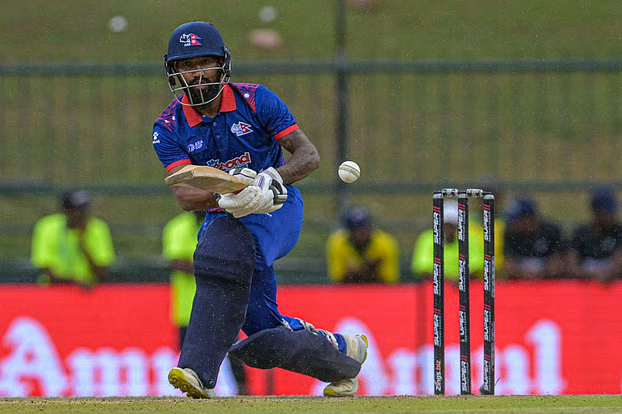
Dipendra Singh Airee’s Nine-Ball Fifty
Gavaskar also brought up the record for the fastest fifty in men’s international T20 cricket.
Nepal’s Dipendra Singh Airee smashed a half-century from just nine balls, breaking Yuvraj Singh’s previous record of 12 balls. Yuvraj had set his mark against England during the 2007 World Cup, famously hitting six sixes in an over from Stuart Broad.
Dipendra later broke that record against Mongolia in 2023.
Gavaskar acknowledged Nepal’s rapid development and pointed to their strong performances against higher-ranked opponents. But he questioned whether records achieved when Associate nations dominate other Associate teams should automatically be viewed in exactly the same context as records against established cricketing nations.
Could Ranji Trophy Follow the Same Model?
Gavaskar’s proposal is not limited to international cricket. He also suggested that India’s domestic Ranji Trophy could consider a similar approach.
His concern is that records produced in matches involving relatively weaker teams in the Plate group could overshadow achievements against stronger opposition.
The central idea, therefore, is not necessarily to erase such records from the books. Instead, Gavaskar wants the level of competition to become part of the statistical context.
If cricket were to adopt a football-style division system, a record would come with an additional layer of information—not just what was achieved, but against what level of opposition it was achieved.