
Manchester City: Complete Club History, Major Trophies and All-Time Records
97 Repoter: 97 Admin
Publish : 2 hours agoUpdate: 11 minutes ago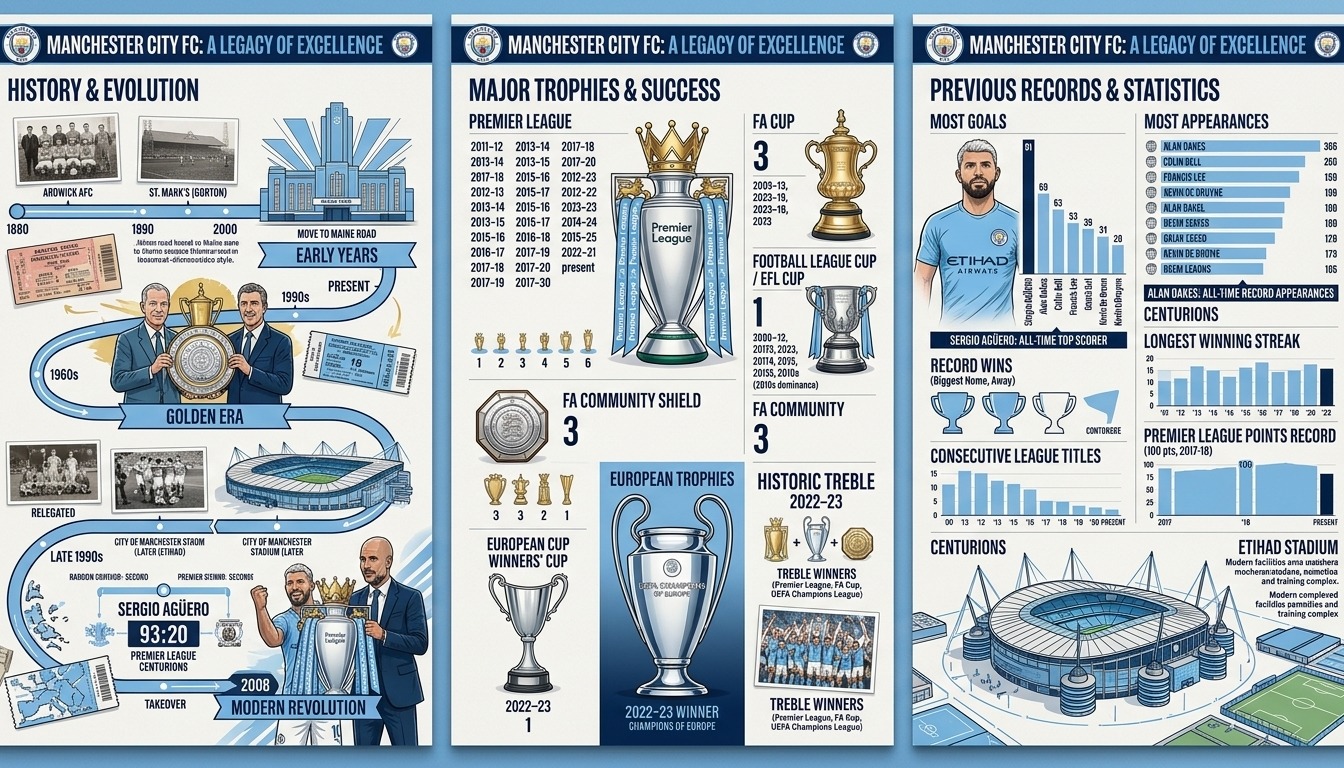
Manchester City: Complete Club History, Major Trophies and All-Time Records
Manchester City: Complete Club History, Major Trophies and All-Time Records
Manchester City’s rise is one of the most remarkable stories in English football. The club has experienced financial difficulties, relegation battles and long periods without major trophies. In the modern era, however, City have become one of the dominant forces in the game, winning multiple Premier League titles, lifting their first UEFA Champions League trophy and completing a historic continental Treble in 2023.
Yet Manchester City’s story began long before their modern success. Founded in 1880 as a local football team, the club became Manchester City Football Club in 1894. Its history includes early FA Cup triumphs, legendary players, dramatic title races and record-breaking seasons.
The Founding of Manchester City
Manchester City’s roots date back to 1880, when a football team associated with St Mark’s Church in West Gorton, East Manchester, was formed. The team was initially known as St Mark’s before becoming Ardwick AFC in 1887.
In 1894, the club was reorganised and adopted the name Manchester City Football Club, reflecting its ambition to represent the wider city.
City won their first major trophy in 1904, defeating Bolton Wanderers in the FA Cup final. It was the first major trophy won by a club from Manchester.
After playing at Hyde Road, the club moved to Maine Road in 1923. In 2003, City relocated to the City of Manchester Stadium, now known as the Etihad Stadium.
Early League Titles and the Golden Era of the 1960s
Manchester City won their first English top-flight league title in the 1936–37 season. After the Second World War, the club rebuilt and enjoyed another successful period during the 1960s.
Under Joe Mercer and Malcolm Allison, City won the Second Division in 1965–66 and returned to the top flight. They then captured the First Division title in 1967–68.
City won the FA Cup in 1969 and completed a memorable domestic and European cup double in 1969–70 by lifting both the League Cup and the European Cup Winners’ Cup.
Difficult Years and the Road Back
Following their successes in the 1960s and early 1970s, Manchester City endured difficult decades. They lost the 1981 FA Cup final to Tottenham Hotspur and experienced relegation and promotion battles during the 1980s and 1990s.
In 1998–99, City found themselves in the third tier of English football. They secured promotion by defeating Gillingham in a dramatic play-off final and returned to the second tier. In 2001–02, they won the second-tier championship and moved back into the top flight.
The move to the Etihad Stadium in 2003 provided an important foundation for future growth. A major turning point arrived in 2008, when new Abu Dhabi-based ownership brought significant investment to the club.
A New Era After 2008
Following the ownership change, Manchester City invested heavily in players, facilities and long-term development. The club began attracting world-class talent and established itself as a regular contender for major honours.
City ended a 35-year wait for a major trophy by winning the FA Cup in 2010–11. Their next achievement was even more dramatic.
On the final day of the 2011–12 Premier League season, Sergio Aguero scored a stoppage-time winner against Queens Park Rangers to secure City’s first top-flight league title since 1968. The goal remains one of the most iconic moments in Premier League history.
City won another league title in 2013–14 before reaching a new level of consistency under Pep Guardiola.
Pep Guardiola and a Record-Breaking Team
Pep Guardiola became Manchester City manager in 2016. Under his leadership, City developed a distinctive style based on possession, precise passing, attacking movement and tactical flexibility.
In 2017–18, City became the first team to reach 100 points in a Premier League season. They also recorded 32 league victories and scored 106 goals.
The 2018–19 campaign brought another historic achievement. City won the Premier League, FA Cup, League Cup and Community Shield, becoming the first men’s team in English football to win all four major domestic trophies in a single season.
City then won four consecutive Premier League titles from 2020–21 through 2023–24. They became the first men’s team in English top-flight history to win the championship in four successive seasons.
Champions League Glory and the Historic Treble
Winning the UEFA Champions League had long been one of Manchester City’s biggest ambitions. The club reached its first final in 2020–21 but lost to Chelsea.
City finally lifted the trophy in 2022–23, defeating Inter Milan 1–0 in Istanbul. Rodri scored the decisive goal, securing the most significant European triumph in the club’s history.
That season, City also won the Premier League and FA Cup. By completing the Treble, they became only the second English club, after Manchester United in 1998–99, to win the Premier League, FA Cup and Champions League in the same campaign.
City added the UEFA Super Cup and FIFA Club World Cup in 2023. They became the first English club to hold the Champions League, Premier League, FA Cup, UEFA Super Cup and FIFA Club World Cup titles simultaneously.
Manchester City’s Major Trophies
According to the club’s official honours list, Manchester City’s men’s first team had won the following major honours by the end of the 2025–26 season. <Cite refs={["turn714053search1","turn714053search3"]}/>
| Competition | Titles | Most recent title |
|---|---|---|
| English league / Premier League | 10 | 2023–24 |
| FA Cup | 8 | 2025–26 |
| League Cup | 9 | 2025–26 |
| FA Community Shield | 7 | 2024 |
| UEFA Champions League | 1 | 2022–23 |
| European Cup Winners’ Cup | 1 | 1969–70 |
| UEFA Super Cup | 1 | 2023 |
| FIFA Club World Cup | 1 | 2023 |
City have also won the English second-tier championship seven times. Overall trophy totals can vary depending on whether competitions such as the Community Shield, second-tier titles and other honours are included.
Manchester City’s Greatest Players
Sergio Aguero: City’s all-time leading goalscorer, with 260 goals in all competitions. His stoppage-time winner against QPR in 2012 secured one of the most famous league titles in English football.
Vincent Kompany: The former Belgian defender and captain played a central role in City’s rise. His leadership helped the club win multiple league titles, while his long-range strike against Leicester City in 2019 remains memorable.
David Silva: One of City’s most influential creative players. His vision, passing and ball control helped shape the club’s attacking identity.
Yaya Toure: A powerful midfielder known for his strength, driving runs and ability to score decisive goals. He played a major role in City’s early modern success.
Kevin De Bruyne: One of the defining playmakers of the Guardiola era, renowned for his passing range, chance creation and influence in crucial matches.
Erling Haaland: The Norwegian striker made an immediate impact after joining City. He scored 36 Premier League goals in 2022–23, setting the record for the most goals in a 38-game Premier League season.
Manchester City’s Major Club Records
The club’s official historical records include several remarkable achievements. <Cite refs={["turn714053search2","turn714053search4"]}/>
Most Premier League points in a season: 100 in 2017–18.
Most goals in a Premier League season: 106 in 2017–18.
Most league goals in a season: 108 in the Second Division in 1926–27 and 108 in the First Division in 2001–02.
Most goals in a season across all competitions: 169 in 2018–19.
Most Premier League goals by a player in one season: Erling Haaland’s 36 in 2022–23.
All-time leading goalscorer: Sergio Aguero, with 260 goals.
Most appearances for the club: Alan Oakes, with 680 matches.
Longest winning streak across all competitions: 21 matches, from December 2020 to March 2021.
Record FA Cup victory: 12–0 against Liverpool Stanley in 1890.
Records can change as new seasons are completed, so figures should be checked against the club’s latest records before publication.
Managers Who Shaped Manchester City
Several managers have played important roles in Manchester City’s history. Joe Mercer and Malcolm Allison led the club through a successful period in the late 1960s. Roberto Mancini delivered the 2011–12 Premier League title, while Manuel Pellegrini guided City to another league championship in 2013–14.
Pep Guardiola, however, has overseen the club’s most sustained period of success. His teams have won multiple Premier League titles and domestic cups, along with City’s first Champions League trophy. The four domestic honours of 2018–19 and the continental Treble of 2022–23 stand out among the defining achievements of his tenure.
Manchester City’s Greatest Rivalries
Manchester United are City’s principal local rivals. Their meetings, known as the Manchester Derby, represent more than a contest for local bragging rights: they reflect the history, identity and passion of football in the city.
In the modern Premier League era, City have also developed intense title rivalries with Liverpool and Arsenal. European clashes against clubs such as Real Madrid, Bayern Munich and Paris Saint-Germain have become important chapters in their recent history.
Conclusion
Manchester City’s journey demonstrates how long-term planning, investment, infrastructure, player development and tactical decisions can transform a football club. From their first FA Cup triumph in 1904 to the Champions League victory and Treble of 2023, City’s history combines generations of success and setbacks.
Today, Manchester City are among the most successful clubs in English football. Their trophies, records and influence on the modern game have made them a globally recognised name. What comes next will depend on the club’s future recruitment, coaching decisions and ability to remain competitive.